
Kanabec County Mugshot Records
A mugshot is a photograph taken by law enforcement to identify a person in connection with an arrest. In Minnesota, Minn. Stat. § 13.82, subd. 26 classifies a qualifying law-enforcement booking photograph as public data. The agency may temporarily withhold the image when access would adversely affect an active investigation.
Public status does not change the meaning of the image. A booking photo documents identification at arrest. It does not establish guilt, conviction, the outcome of a charge, or the person’s current custody. The Kanabec locator itself warns that booking data do not establish guilt and that the information should be confirmed with official sources.
Release creates a separate record event. A current image may vanish when the booking drops off the roster, yet the underlying agency file may remain. Conversely, a photo that persists elsewhere does not show whether the person was released, transferred, or still held. Use the jail event, VINE event, court order, or receiving-agency record to answer custody questions.
Find Kanabec County Release Mugshots
The best channel depends on where the photo originated and whether the booking remains current. Kanabec County has no official released-person photo archive and no identified sheriff inmate app. That makes a records request the durable official route after the current locator entry disappears.
| Channel | Has a photo? | How to access it |
|---|---|---|
| Kanabec current-inmate locator | Yes, when the detail offers “Click to View Image” | Search the current booking by name and match identifiers |
| Sheriff Records | Qualifying booking photo may be released | Submit a precise data request by email, fax, mail, or in person |
| Kanabec sheriff mobile app | No official app was found | Do not substitute a generic jail app |
| MNDOC Public Viewer | No portrait appeared in reviewed standard details | Ask DOC Records whether a releasable correctional image exists |
| VINELink | Not a permanent photo archive | Use it for a specific county-jail custody event, not image retention |
| News or secondary booking source | Sometimes | Use only a directly relevant item and verify all facts officially |
These channels hold different records. A newsroom photograph, a law-enforcement press image, an arrest booking photo, and a prison identification image are not interchangeable. Label the source before drawing any conclusion.
Kanabec County Locator Photos
The official Kanabec current-inmate locator is the first official online photo source while a booking remains active. Search inputs include last name, first name, gender, and four-digit birth year. The detail may show booking number, SPN, identity data, custody date, Booking Status, court branch, case number, charges, bail, holds, and a click-to-view image.
Those bridge fields matter. Save the booking number, SPN, custody date, and court file number before the row disappears. They allow Sheriff Records to locate the right image and help distinguish two people with similar names. A common name by itself can attach the wrong photo to the wrong case.
The manifest capture below comes from the Kanabec County inmate locator and shows the search structure and current-detail context.
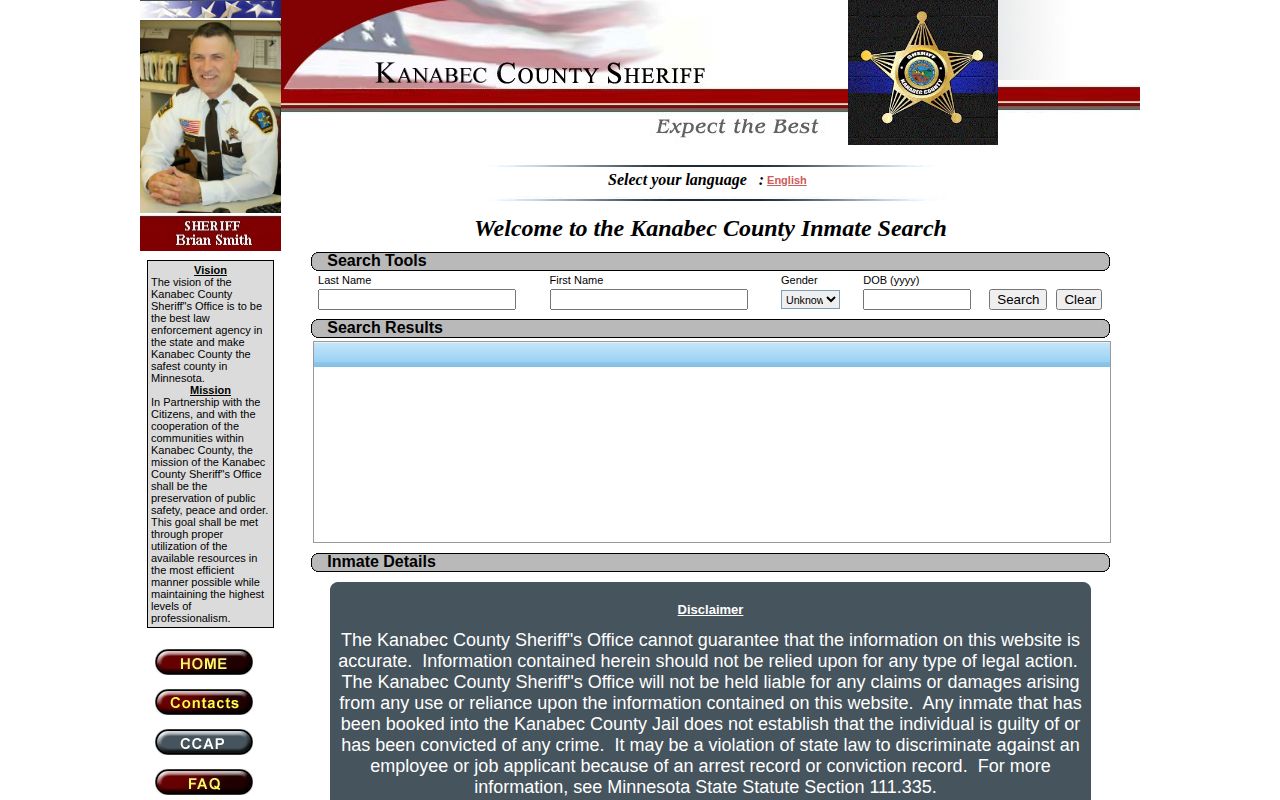
The interface has no released tab, 24-hour release view, 72-hour archive, or promised post-release retention period. Once the person is no longer a current result, move to the official request route instead of inferring an exact release time from disappearance.
Note: “Booking Status” describes an operational booking field and should not be rewritten as a verified release disposition.
After Kanabec County Mugshots Disappear
Kanabec’s photo policy has a distinctive split. The official locator can show a click-to-view image while the person is currently listed, but the county publishes no former-inmate image gallery. No official sheriff mobile roster or release app was found in the county sources. After the row vanishes, Sheriff Records becomes the main official path.
The county request form lists photos at $5. The Sheriff Records webpage also lists photos at $5 per page or photo medium. Because the form and web fee descriptions are not worded in exactly the same way, ask for an estimate and request electronic delivery when available. Free inspection may help when a copy is not needed.
A photo that remains on a secondary booking mirror is not an affirmative release record. Such sources can preserve old arrest material after an official row changes. They cannot identify the actual exit time, release reason, another hold, or a transfer. Confirm the custody event through Sheriff Records, the court file, VINE, or the receiving agency.
Request Kanabec County Booking Photos
Kanabec Sheriff Records accepts data requests through its official form and contact channels. The form asks for the incident date and a description of the data. Requester identity and contact details are optional unless staff need them to deliver copies or clarify the request. The available delivery choices include inspection, pickup, email, mail, and other methods.
- Gather the full name, date of birth, booking or SPN number, approximate custody date, and court file number.
- Open the Kanabec Sheriff data-request form. Ask for the booking photograph taken for identification in connection with the named arrest.
- State the exact booking. If release verification also matters, separately request the public booking and release record, including actual release time and disposition if maintained.
- Choose inspection or an electronic copy when practical. Ask Records to confirm the charge before the copy is made.
- Submit by email to Sheriffrecords@co.kanabec.mn.us, by fax to 320-679-8422, or in person. Call 320-679-8418 before mailing because the web page and form differ on the street designation.
The official Sheriff Records page shows the request contacts and fee routes captured below.
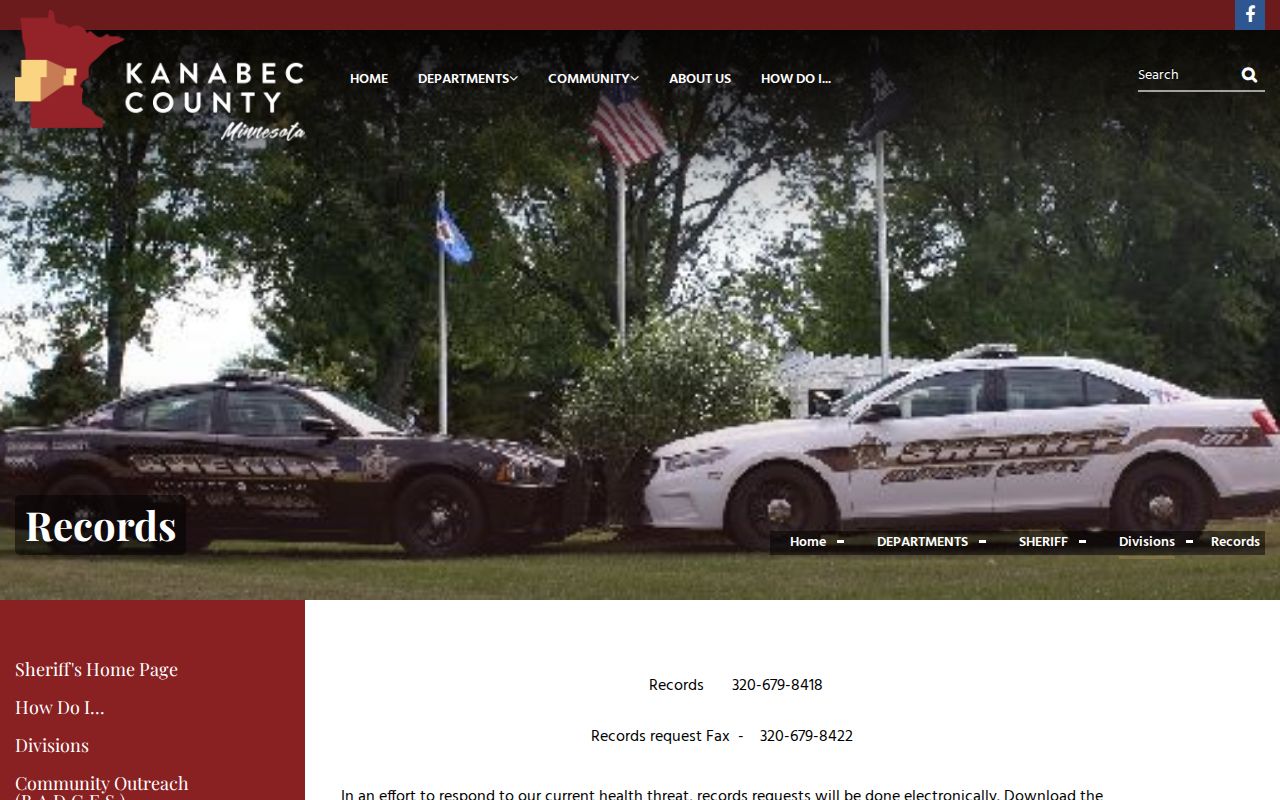
The records page supports the official fallback when the current locator no longer displays the image. If a field is withheld, ask the agency to identify the statutory classification. Agencies need not create a new narrative or a record they do not maintain.
The request can also ask for the public release fields tied to that booking. Keeping the photo request and custody-event request distinct helps Records locate existing data without being asked to explain why a court or jail made a decision. If the agency maintains separate image and release records, request both by the same booking number and custody date. That preserves the link while respecting the different purposes of each record.
Kanabec County State Prison Photos
A Kanabec prosecution can result in commitment to a Minnesota prison outside the county. The MNDOC Public Viewer is the right source for custody and supervision status under state corrections. However, the standard offender details reviewed during research did not display a portrait. It should not be promoted as a photo gallery.
MNDOC Records Management can be asked whether a publicly releasable correctional identification image exists. Provide the six-digit MNDOC ID, full name, date of birth, and a clear description of the requested image. The agency may classify or redact correctional data under Minn. Stat. § 13.85, especially when safety, investigative, medical, or institutional concerns apply.
The arrest-booking-photo rule does not automatically classify every prison portrait. Section 13.82, subd. 26 concerns a law-enforcement photograph taken for identification in connection with an arrest. A correctional identification image may arise from a different record system and legal classification. DOC Records Management is at CO-Records.DOC@state.mn.us and 651-361-7330.
Kanabec County Secondary Photo Sources
Commercial booking mirrors may retain Kanabec arrest images after the official current row disappears. They are secondary discovery leads only. No commercial mugshot publisher, data broker, or removal service is linked or endorsed. Their dates may describe booking, page update, or republication rather than release.
A specific local news report may include a photo connected to an arrest, court case, or agency announcement. Read the caption and source credit. A newsroom image may be an ordinary photograph. A law-enforcement press image may differ from the original booking photo. Neither proves what happened after custody.
Use official records to settle identity and status. The Kanabec County released inmate record path combines the current locator, VINE, Sheriff Records, and court disposition. Minnesota Court Records Online can clarify whether charges were dismissed, stayed, resolved, or followed by probation, but a court record may not include the exact jail-release minute.
Note: Arrest, booking, charging, conviction, release, and final discharge are separate events that should never be collapsed into one label.
Kanabec County Mugshot Sealing
Minnesota expungement under Chapter 609A seals records rather than destroying them. Automatic relief applies only when all statutory conditions are met, and petition relief depends on the outcome and offense. A temporary court notice does not guarantee that sealing is final. Review the Minnesota Judicial Branch expungement information and the actual order.
Sealing can change public access even though an agency still retains data. It does not prove that an event never occurred. If a government search displays an error, Minn. Stat. § 13.04 provides a route to challenge the accuracy or completeness of government data. Court-record corrections follow court procedures.
No enacted Minnesota law specifically banning pay-to-remove mugshot publication was found in the current-law sweep. A past proposal is not current law. Removal requests to a news or secondary publisher depend on that publisher’s policy and the specific legal facts. Do not pay a service based on a promise that an official record will vanish.
For an official Kanabec image, begin with Sheriff Records and provide any sealing or correction order that directly applies. For a state correctional image, contact MNDOC Records Management. Each source controls its own record and must apply the relevant statute or court order.
When a request concerns the requester’s own government data, § 13.04 also supplies access and accuracy-challenge rights. Agency access to a data subject is generally immediate or within ten working days under the researched rule. That timeline concerns access to maintained data, not a guarantee that every requested image is public or that staff will create a missing photo.