
Kanabec County Parole and Probation
Probation and prison release are not the same event. Probation is a court-ordered sentence or condition served in the community. A person can receive probation without first serving a state-prison term. Minnesota usually calls the community part of a modern state-prison sentence supervised release, not parole. The person has left physical prison but remains within Minnesota Department of Corrections jurisdiction until the sentence expires or another lawful discharge occurs.
Parole applies to narrower groups reviewed under Minnesota law, including eligible life or indeterminate sentences and certain other long-sentence classes. The Minnesota DOC Supervised Release Board handles those statutory cases. It is not a universal board for all people leaving prison. Ordinary fixed sentences generally move to supervised release under Minn. Stat. § 244.05 without a discretionary parole grant.
| Type | Who controls it | Useful confirmation |
|---|---|---|
| County probation | Kanabec Probation and the Tenth Judicial District | Court order, probation office confirmation, and later discharge entry |
| Felony probation | Minnesota Department of Corrections | MNDOC Public Viewer, court record, or named supervising agency |
| Supervised release | MNDOC after state-prison confinement | “Under Supervision as of,” agent, agency, and expiration fields |
| Limited parole cases | MNDOC Supervised Release Board | Board schedule, minutes, written decision, and MNDOC status |
Release from custody and discharge from supervision are separate milestones. A status that shows community supervision confirms physical release from prison, but it does not show that the full sentence has ended.
Verify Kanabec County Post-Release Supervision
Start with the sentence source. A county misdemeanor or gross-misdemeanor case belongs on a different path from a felony commitment to the Commissioner of Corrections. Use exact identifiers when possible. A full name, date of birth, court file number, and six-digit MNDOC ID reduce the risk of joining the wrong person to the wrong supervision record.
- Check the case disposition in Minnesota Court Records Online. Read the sentencing order, probation conditions, commitment entries, violations, and any probation-discharge entry.
- For felony probation or release from state prison, search the MNDOC Public Viewer by first and last name or the complete offender ID.
- Read the literal status. “Under Supervision as of” or “Under Intensive Supervised Release,” plus the listed agency and agent, supports active DOC supervision.
- For an adult misdemeanor or gross-misdemeanor case, contact Kanabec Probation with the court file number. Ask only for information the office may lawfully disclose.
- If a possible violation is involved, check the official county warrant source and MNDOC Fugitive Search. Confirm any result with the issuing agency.
The public viewer is jurisdiction-based, not a permanent archive. A person can disappear after final DOC discharge. A miss can also result from a name variation, a new commitment that has not posted, or a county-only case. The court file and the appropriate records office are the durable fallbacks. The broader Kanabec County released inmate search explains how to reconcile jail, court, and corrections records after custody ends.
An official public example shows the supervision fields in context. Open the live MNDOC offender detail before comparing its current wording with the captured interface.
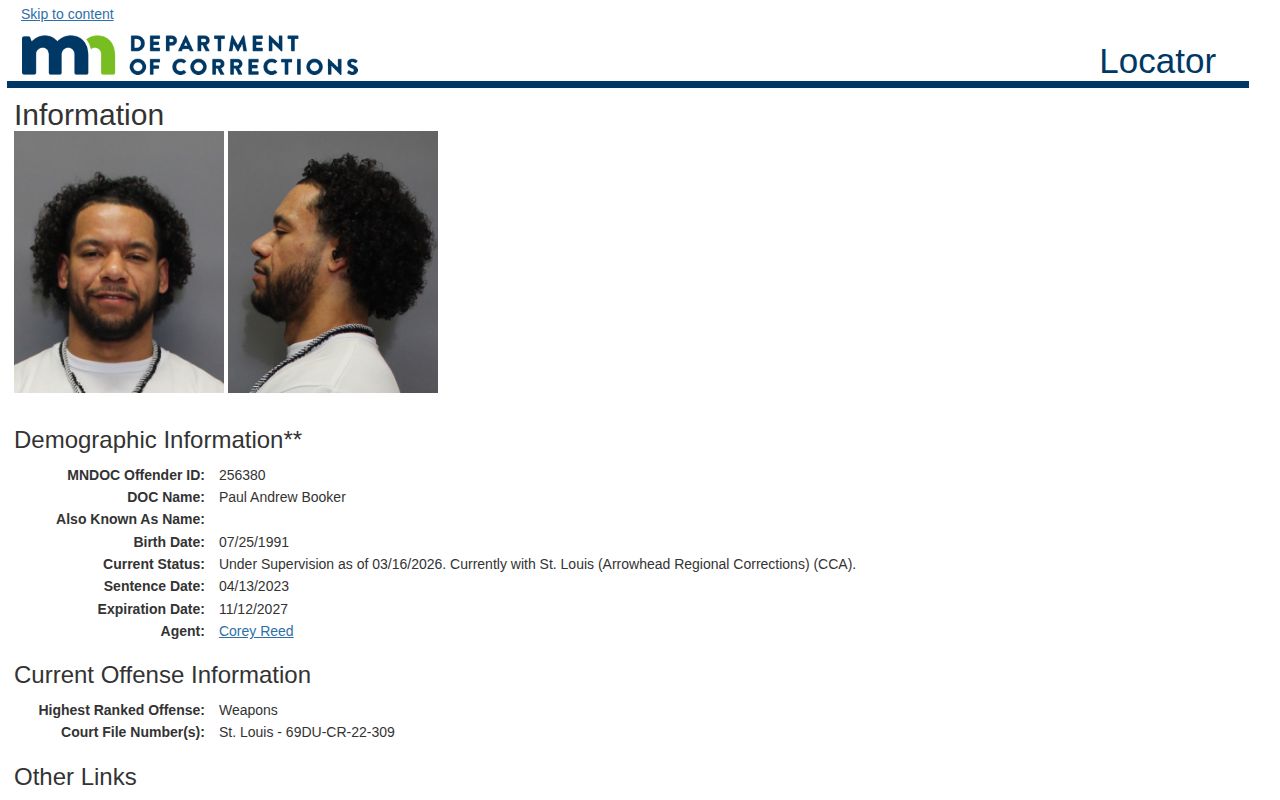
The image illustrates “Under Supervision as of,” agent or agency, and expiration fields. It does not establish that the same status remains current for any other person.
Note: A current supervision record is stronger than roster disappearance because it identifies the agency that still holds legal jurisdiction.
Kanabec County Supervision Jurisdictions
Kanabec County has a clear local split. Kanabec Probation supervises adult misdemeanor and gross-misdemeanor cases, along with juvenile matters, for the Tenth Judicial District. MNDOC supplies supervision for felony probation and for people released from state prison. The conviction and sentence type therefore determine which office can confirm active supervision.
Sending every question to county probation can cause delay. A felony case may be assigned to an MNDOC field agent even when the person lives in Mora or elsewhere in Kanabec County. Conversely, a local gross-misdemeanor probation term may have no MNDOC Public Viewer entry. Read the court’s level of offense and sentence first, then use the agency shown in the resulting order or locator record.
Kanabec Probation
317 Maple Avenue East, Suite 233
Mora, MN 55051
Phone: 320-679-6450
Fax: 320-679-6455
Monday–Friday, 8:00 a.m.–4:30 p.m.
Pretrial supervision is another category. It may begin after a bond or court-ordered release while the case is still pending. That is not probation after conviction, and it is not parole. The release order and Court Services record identify the actual status.
Kanabec County Release Reporting
Kanabec Court Services has an unusually specific post-release process. Its official comprehensive plan says staff review the jail’s in-custody roster each workday for pretrial bail evaluations using the Minnesota Pretrial Assessment Tool-Revised. When a court orders pretrial supervision, the person commonly must report to Court Services right after release or within 24 hours.
At that first contact, staff record contact details, explain release terms, and set a reporting schedule. This creates a useful bridge from the jail event to a court-supervision record. It can support that a person entered community supervision, but it does not replace the jail’s actual release record. The court order remains the source for conditions. Jail Housing or Sheriff Records remains the source for the completed departure time.
Court Services may also help administer court-ordered electronic monitoring or electronic alcohol monitoring. Community monitoring still carries enforceable terms. A violation can lead to a summons, warrant, or an Apprehend and Detain order under the circumstances described in the county plan.
Kanabec County Probation Warrants
Kanabec County’s warrant system includes District Court warrants and Probation Officer Arrest and Detention orders. The official county warrant page says its public database publishes automatically each night. That makes it useful for checking whether a supervision issue has produced a public warrant entry, but the county warns that the list can lag.
A warrant record does not prove present custody. It shows an unresolved order attributed to the issuing authority. Likewise, the lack of a name on the nightly list does not prove that supervision ended or that no order exists. Confirm a Kanabec result with the issuing agency or Dispatch at 320-679-8400 before treating it as current.
For alleged violations of MNDOC community supervision, use the MNDOC Fugitive Search. MNDOC describes listed people as serving the community portion of a sentence who are alleged to have violated release conditions and evaded authorities. The Fugitive Unit can be reached at 651-643-3532, with 24-hour tips at 651-603-0026. A fugitive listing means MNDOC still asserts jurisdiction. It is not proof of a completed revocation or a new jail booking.
Note: Verify the date and issuing office because the county warrant list and MNDOC fugitive list answer different questions.
Kanabec County Release Conditions
Conditions vary by order and supervision type. Common records may address reporting, travel, treatment, testing, contact limits, electronic monitoring, or compliance with other court terms. The public record may not show every operational instruction. Read the signed order and contact the named agent for the current terms when disclosure is allowed.
A violation allegation is not the same as a final finding. MNDOC’s Hearings and Release Unit approves release conditions and handles warrants, detention, violation, and revocation proceedings within its role. A court handles county probation violations. In either system, the later order or hearing result shows whether conditions changed, supervision continued, or custody was imposed.
- Supervised release
- The community portion of a Minnesota state-prison sentence while MNDOC jurisdiction continues.
- Probation
- A court-ordered community sentence or condition supervised by the agency assigned to the case.
- Absconder
- A person alleged to have stopped reporting or evaded supervision while jurisdiction remains active.
- Revocation
- A formal decision that can return a supervised person to custody after the required process.
- Discharge
- The legal end of a supervision term or agency jurisdiction, not just release from a building.
Kanabec County Parole Review
The Supervised Release Board reviews only the sentence classes assigned by Minnesota law. Its official schedule page provides an upcoming agenda, a regularly updated review schedule, and recent agendas, minutes, and recordings. Those meeting records remain available for a limited period, generally about 90 days, so retrieval dates matter.
No separate person-searchable decision database was found. Approved minutes are the closest public results source, while annual legislative reports provide broader outcome data. At an eligible review, the Board may assign a projected release date or continue the case with directions. It cannot release someone before the applicable minimum eligibility date.
Board review differs from a later violation or revocation hearing. Eligibility turns on the precise sentence and statute, and life without release is excluded. Confirm the sentence class in the court record, then compare it with Minn. Stat. §§ 244.049 and 244.05. Do not apply a life-sentence timeline to an ordinary determinate case.
Kanabec County Supervision Discharge
Supervision ends through a lawful expiration, discharge, court order, or other process that fits the sentence. The MNDOC detail may show an Expiration Date, but that field is not the same as the date physical prison confinement ended. Earned compliance credit can support consideration of active-supervision abatement under Minnesota law. Abatement ends active supervision, yet it does not change the sentence’s legal expiration date.
For county probation, look for a probation-discharge entry or order in the court file. For MNDOC jurisdiction, save the status and expiration details while the record is public, then ask Central Records if final discharge needs documentary confirmation. Records Management can be reached at 651-361-7330 or CO-Records.DOC@state.mn.us.
A released person can therefore pass through several distinct stages: physical release, active community supervision, reduced or abated supervision, and final discharge. Only the last step ends the relevant supervision term. Naming the stage accurately prevents a projected date, community status, or missing search result from being mistaken for discharge.